
THE SACRAMENT OF HOLY ORDERS

And Michas said:
Stay with me, and be unto me a father and a priest,
and I will give thee every year ten pieces of silver,
and a double suit of apparel, and thy victuals.
Judges 17, 10
Even if you had ten thousand guardians in Christ,
you do not have many fathers, for in Christ Jesus
I became your father through the gospel.
1 Corinthians 4, 15
The passage from 1 Corinthians 4:15 underscores the unique role that spiritual fatherhood plays within the Catholic faith. In this context, Paul emphasizes his paternal relationship with the Corinthian community, recognizing his role as their spiritual father through the preaching of the Gospel. In Catholicism, the concept of spiritual fatherhood is significant. It reflects the idea that within the Church, certain individuals—like priests, bishops, and even lay leaders—have a responsibility to guide, nurture, and help others grow in their faith. Just as a biological father provides guidance and support in a family setting, a spiritual father offers spiritual nourishment, helping others to deepen their relationship with God.
The phrase “Though you have ten thousand guardians in Christ” suggests that while there may be many teachers and leaders in the community, not all fulfill the intimate and nurturing role of a father. This highlights the importance of authenticity in spiritual guidance—it’s not just about imparting knowledge but also about fostering a relationship based on love, care, and mentorship. In the Catholic tradition, this fatherly role is exemplified in the Sacrament of Holy Orders, where priests are called to shepherd their flock with compassion and dedication. It also resonates with the Church’s understanding of God as a loving Father, reinforcing the idea that spiritual relationships are not only hierarchical but also familial.
The priesthood of the New Covenant has its roots in the priesthood of the Old Covenant. God’s chosen people have constituted “a kingdom of priests and a holy nation” (Ex 19:6; Isa 61:6). But from among the twelve tribes of Israel, God chose the tribe of Levi and set it apart to minister liturgical service (Num 1:48-53; Josh 13:33). The Levite priests were “appointed to act on behalf of men to God, to offer gifts and sacrifices for sins” (Heb 5:1; cf. Ex 29:1-30; Lev 8). This priesthood was instituted to proclaim the Word of God and restore communion with God by sacrifice and prayer (Mal 2:7-9). However, this priesthood was powerless in bringing about salvation in the Christian meaning. The sacrifices for sin had to be repeated ceaselessly. They could not achieve definitive sanctification and justification, which only Christ’s single sacrifice of himself could and would accomplish at the appointed time in salvation history (Heb 5:3; 7:27; CCC 1539, 1540).
In the New Covenant, two participations exist in the one priesthood of Christ between the laity and the clergy. Our High Priest and unique mediator between God and humanity has made his Church “be a kingdom and priests to serve his God and Father” (Rev 1:6). We who are baptized “like living stones, are being built into a spiritual house to be a holy priesthood, offering spiritual sacrifices acceptable to God through Jesus Christ” (1 Pet 2:5). God’s chosen people in the New Dispensation are “a royal priesthood, a holy nation, God’s special protection” (1 Pet 2:9). The entire community of believers, therefore, is as such priestly in their baptismal vocation according to their particular spiritual gifts. Christians are anointed first and foremost in the Sacrament of Baptism and then again when their baptismal grace is perfected in the Sacrament of Confirmation.
The Sacrament of Holy Orders and the ministerial priesthood have a biblical basis. We find the verb form for the noun hiereus or ἱερεύς in the New Testament. The word means “priest” or one who “sacrifices to a god.” Paul writes to the church in Rome: “Nevertheless, brethren, I have written the more boldly unto you in some sort, as putting you in mind, because of the grace that is given to me of God, That I should be the minister of Jesus Christ to the Gentiles, ministering (hierourgounta / ἱερουργοῦντα) the gospel of God, that the offering up of the Gentiles might be acceptable, being sanctified by the Holy Ghost” (Rom 15:15-15, KJV). What we literally have is “to be a minister of Christ Jesus to the Gentiles, ministering as a priest the gospel of God” (NASB), “the priestly duty of proclaiming the gospel of God” (NIV), or “in the priestly service of the gospel of God” (ESV).
The Revised Standard Version Catholic Edition (RSVCE) has this: “But on some points I have written to you very boldly by way of reminder, because of the grace given me by God to be a minister of Christ Jesus to the Gentiles in the priestly service of the gospel of God, so that the offering of the Gentiles may be acceptable, sanctified by the Holy Spirit.” Thus, the ministers of the New Covenant were essentially priests and had priestly tasks. Their supreme act was to offer up the Eucharistic sacrifice to God in worship (1 Cor 10:16, 18, 20; 11:26; Heb 13:10, 15). No ministerial priestly function is ascribed to deacons, but there is to apostles, bishops, and elders.
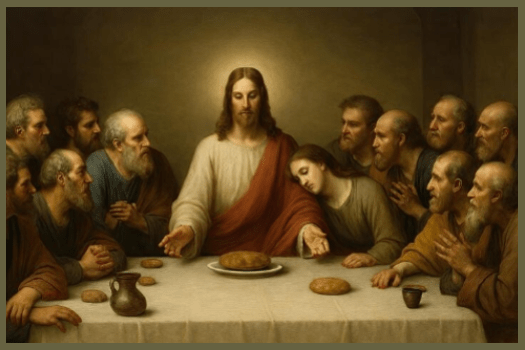
Our Lord Jesus definitively chose and sent his apostles to act like priests or “mediators between God and men.” For instance, after the Resurrection, our Lord appeared to the apostles and said to them: “Peace be with you. As the Father has sent me, even so, I send you.” And when he said this, he breathed on them and said, “Receive the Holy Spirit. If you forgive the sins of any, they are forgiven; if you retain the sins of any, they are retained”(Jn 20:21-23). On this occasion, Jesus communicates or transfers the sacred power to forgive and retain sins. The apostles are to do what the Lord has done in his priestly ministry with divine authority. The power or authority Jesus invests in them is the one he has been invested in by God the Father in his humanity (Mt 5:17-26).
Ministering the Sacrament of Reconciliation is a ministerial priestly task rooted in the Old Covenant. For example, ‘ but he shall bring a guilt offering for himself to the Lord, to the door of the tent of meeting, a ram for a guilt offering. And the priest shall make atonement for him with the ram of the guilt offering before the Lord for his sin which he has committed; and the sin which he has committed shall be forgiven him’ (Lev 19:21-22, RSVCE). Therefore, the New Covenant priests’ ordination began with Jesus and the apostles. The Sacrament of Holy Orders was instituted by Christ himself at the Last Supper together with the institution of the Holy Eucharist.
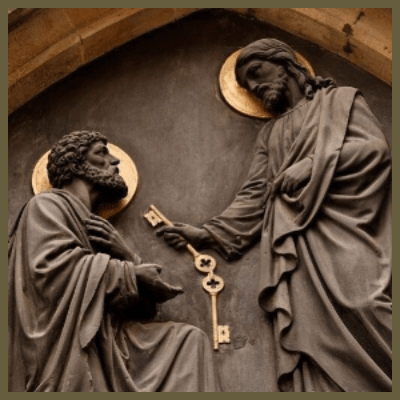
The Scriptures reveal that the ordained ministers of the nascent New Covenant Church had a share in Christ’s priestly ministry and authority that originated from the Father. Jesus says he does nothing of his own authority. Likewise, the apostles will do nothing on their own authority but on the same authority that comes from God (Jn 8:28). The Father’s authority is transferred to the Son. The Son does not speak on his own. This is a transfer of divine authority (Jn 12:49). Jesus gives his apostles what the Son has been given from the Father (Jn 16:14-15). The authority isn’t lessened or mitigated. Jesus declares to His apostles, “He who receives you, receives Me, and he who rejects you, rejects Me and the One who sent Me” (Mt 10:1, 40). Jesus gives the apostles the authority to make visible decisions on earth that will be ratified in heaven (Mt 16:19; 18:18). The power to “bind and loose” was given to the priests of the Old Covenant. Jesus tells his apostles that “he who hears you, hears me” (Lk 10:16). When we listen to our bishop on matters of faith and morals, we listen to Christ whom he represents.
The Christian faith is built upon the foundation of the apostles. The word “foundation” shows that the apostolic teaching authority does not die with the apostles but carries on through a physical line of succession (Eph 2:20). As soon as Jesus ascends into heaven, Peter implements apostolic succession. Matthias is ordained with full apostolic authority (Acts 1:15-26). Only the Catholic Church can demonstrate an unbroken apostolic lineage to the apostles in union with Peter through the Sacrament of Holy Orders, thereby claiming to teach with Christ’s authority.

At the outset, one had to be ordained by an apostle to witness with the apostles and teach with the authority of Christ, which our Lord had invested in them (Acts 1:21-23). This apostolic authority is transferred through the imposition of hands and has been extended beyond the original Twelve as the Church has grown (Acts 6:6). Paul himself becomes an ordained minister by the laying on of hands (Acts 9:17-19). The sacrament of ordination is necessary to invest Christ’s authority in the ordinand. The apostles and newly-ordained men appointed elders (Acts 14:23). Preachers of the Gospel must be sent by the bishops in union with the Church with the authority that can be traced back to the apostles (Acts 15:22-27). Paul refers to the Sacrament of Holy Orders when he writes, “God has commissioned certain men and sealed them with the Holy Spirit as a guarantee” (2 Cor 1:21-22).
Paul and the council of elders ordain Timothy (1 Tim 4:14). Again, apostolic authority is transferred through the laying on of hands. And Timothy himself is instructed by Paul on how to properly ordain someone by the imposition of hands (1 Tim 5:22; 2 Tim 1:6). Paul uses the word episkopēs (ἐπισκοπῆς) which means “bishop” and thereby requires an office (1 Tim 3:1). Paul’s use of this Greek word presupposes the office of the bishop shall carry on after his death by those who will succeed him through the sacrament of ordination until Christ returns (Mt 28:18-20).
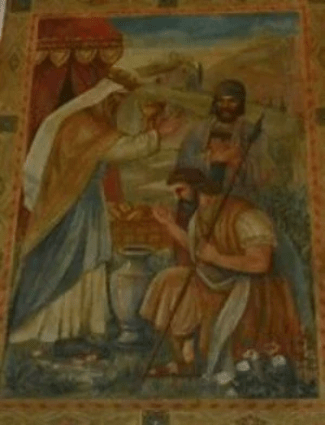
In Catholic tradition, ordained priests are often referred to as “Father,” a practice that has deep roots in biblical history. Dr. Scott Hahn elaborates on this by discussing the distinction between the patriarchal and Levitical periods of the priesthood as outlined in the Old Testament. The patriarchal period, described in the Book of Genesis, is characterized by a religious framework based on the natural family order, where authority is passed from father to son, often the firstborn, typically through a blessing (as seen in Genesis 27). In contrast, the Levitical period, which begins in the Book of Exodus, introduces a structured priestly class and formalized practices, including the establishment of a temple and prescribed sacrifices. During the patriarchal era, there was no distinct priestly institution; instead, patriarchs served as priests, constructing altars and offering sacrifices at locations and times of their choosing, as referenced in Genesis 4:3-4, 8:20-21, and 12:7-8. This natural empowerment of fathers as priests continues to influence the role of the ordained priests in the Catholic Church today.
Dr. Hahn discusses the significance of vestments in relation to priestly office in biblical history. He highlights the moment when Rebekah dressed Jacob in the garments of his brother Esau, which symbolically represented the transfer of the priestly office (Gen 27:15). This transfer is echoed in the following generation when Jacob gives a “long robe” to his son Joseph, illustrating that fatherhood serves as the foundational basis for priesthood (Gen 37:3-4). Hahn explains that the essence of priesthood is rooted in the role of the father, who embodies spiritual authority and performs religious duties, suggesting that priesthood originally belonged to fathers and their “blessed” sons.
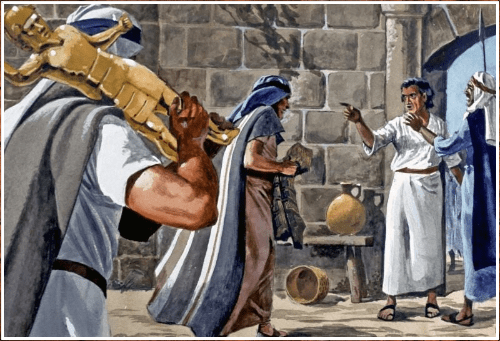
However, as history progressed, the Levitical priesthood evolved into a hereditary office, primarily associated with the cultural elite, resulting in the diminished role of the home as the central place for priesthood and sacrifices. Interestingly, this shift is illustrated in Judges 17:10 where a travelling Levite is invited by Micah to “stay with me, and be to me a father and a priest,” indicating the enduring importance of the fatherly role in spiritual leadership, even within the context of the established priesthood (Signs of Life: 40 Catholic Customs and Their Biblical Roots: Doubleday, 2009).
Hence, when Paul said, “I became your father through the gospel,” he referred to himself as a priest. The community of believers in Corinth comprises his sons and daughters and heirs to the kingdom of heaven. Not unlike Paul, his successors in the Catholic Church – through the Sacrament of Holy Orders – are fathers and priests by their role of representing Christ, their spiritual authority, and religious service: the preaching of the gospel and ministration of the sacraments for the family in the house of God which is the Church.
“See that ye all follow the bishop, even as Jesus Christ does the Father, and the
presbytery as ye would the apostles; and reverence the deacons, as being the
institution of God. Let no man do anything connected with the Church without the
bishop. Let that be deemed a proper Eucharist, which is [administered] either by
the bishop, or by one to whom he has entrusted it. Wherever the bishop shall
appear, there let the multitude [of the people] also be; even as, wherever Jesus
Christ is, there is the Catholic Church. It is not lawful without the bishop either to
baptize or to celebrate a love-feast; but whatsoever he shall approve of, that is also
pleasing to God, so that everything that is done may be secure and valid.”
St. Ignatius of Antioch (c. A.D. 110)
Epistle to the Smyraens, 8
“Since, according to my opinion, the grades here in the Church, of bishops,
presbyters [priests], deacons, are imitations of the angelic glory, and of that economy
which, the Scriptures say, awaits those who, following the footsteps of the apostles,
have lived in the perfection of righteousness according to the Gospel.”
St. Clement of Alexandria (A.D. 202)
Stromata, 6:13
“The Blessed Apostle Paul in laying down the form for appointing a bishop and
creating by his instructions an entirely new type of member of the Church, has
taught us in the following words the sum total of all the virtues perfected in him:
Holding fast the word according to the doctrine of faith that he may be able to
exhort to sound doctrine and to convict gain savers. For there are many unruly
men, vain talkers and deceivers. For in this way he points out that the essentials of
orderliness and morals are only profitable for good service in the priesthood if at
the same time the qualities needful for knowing how to teach and preserve the faith
are not lacking, for a man is not straightway made a good and useful priest by a
merely innocent life or by a mere knowledge of preaching.”
St. Hilary of Poitiers (A.D. 359)
On the Trinity
PAX VOBISCUM
 Catholic Scripture
Leave a comment