
Infant Baptism
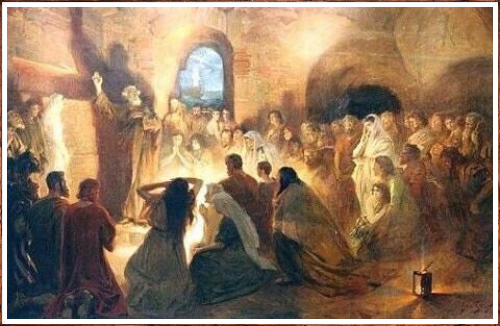
Then Peter said to them, “Repent, and let every one of you be baptized in the name of Jesus Christ
for the remission of sins; and you shall receive the gift of the Holy Spirit. For the promise is to you
and to your children, and to all who are afar off, as many as the Lord our God will call.”
Acts 2, 38-39
They have been told about you that you teach all the Jews living among the Gentiles to forsake Moses, and that you tell them not to circumcise their children or observe the customs.
Acts 21, 21
In Acts 2:38, the Apostle Peter highlights the significance of both repentance and baptism by stating, “Repent and be baptized, every one of you, in the name of Jesus Christ for the forgiveness of your sins, and you will receive the gift of the Holy Spirit.” A deeper examination of the original Greek text provides additional context. The literal translation suggests, “If you repent, then each individual who is part of you and yours must also be baptized” (“Metanoesate kai bapistheto hekastos hymon.”). This interpretation lends support to the practice of infant baptism, positing that children may be baptized based on their parents’ faith. It indicates that families were included in the New Covenant community during the early apostolic era.
In his writings, Peter emphasizes that baptism is pertinent to both children and adults. The phrase “those far off” implies individuals who are primarily in their homes, including infants and children. This indicates that God’s new covenant family encompasses children, similar to how children were included in the old covenant. The term “children” used by Peter is derived from the Greek word teknon (τέκνον), which refers to individuals from birth to adolescence. In this context, teknon is translated as ‘child’ or ‘children’ in the plural form, and it does not refer to future adult descendants. This linguistic choice underscores the inclusion of children within the covenant relationship with God.
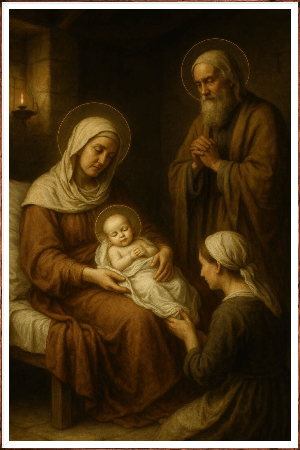
And it came to pass, that on the eighth day they came to circumcise the child;
and they called him Zacharias, after the name of his father.
Luke 1, 59
The passage from the Gospel of Luke provides an important insight into the term “teknon,” which means child of any age in Greek, highlighting that this designation includes infants. In this context, John the Baptist is referred to as a “teknon” during the ritual of his circumcision, marking his entry into the covenant community of Israel. This act was not merely a cultural tradition but a profound spiritual milestone that established his identity within the faith. Furthermore, in Acts 21:21, the term “teknon” is employed to describe very young children, specifically noting eight-day-old infants. This inclusion supports the theological argument that the sacrament of baptism extends to both infants and adults, paralleling the Jewish practice of circumcision, which was traditionally performed on male infants when they were just eight days old.
When the Apostle Peter addressed the adults in his sermons, such as during Pentecost, he emphasized the necessity for them to repent for their sins (Acts 2:38). However, the sacrament of Baptism offers a broader opportunity for grace; regardless of age, all individuals can receive absolution and forgiveness through this sacred rite. The Church teaches that baptism, rooted in faith, serves to wash away the stain of original sin.

A certain woman named Lydia, a worshiper of God, was listening to us; she was from the city of Thyatira and a dealer in purple cloth. The Lord opened her heart to listen eagerly to what was said by Paul. When she and her household were baptized, she urged us, saying, “If you have judged me to be faithful to the Lord, come and stay at my home.” And she prevailed upon us.
Acts 16, 14-15
In the New Testament, we find examples of baptism involving entire households based on the faith of a single individual. For instance, Lydia was baptized along with her “household” after her conversion, highlighting the idea that parents can choose to present their children for baptism based on their faith rather than the children’s conscious belief (Acts 16:15). Similarly, the Philippian jailer, who Paul and Silas converted, was also baptized that night along with his entire household. The text states explicitly he was baptized “with all his family” (Acts 16:33). Additionally, in his correspondence with the church in Corinth, Paul mentions that he baptized the household of Stephanus (1 Cor 1:16). In these passages, Paul uses the Greek term ” oik0n” (οἶκον), which translates to “household” in English. This term is an accusative masculine singular noun that literally means “a dwelling” and, by extension, refers to “a family.” These examples suggest a theological perspective on baptism that encompasses parents’ faith as a valid basis for the baptism of their young children.
This sacrament is considered efficacious when accompanied by genuine faith, whether that faith comes from the individual being baptized or, in the case of infants, through the faith of at least one parent or guardian. This principle is illustrated powerfully in the account of the paralytic, as recorded in the Gospels of Matthew (9:2) and Mark (2:3-5). In these narratives, it is the faith of the friends who brought the paralytic to Jesus that facilitates the man’s healing and the forgiveness of his sins. Similarly, infant baptism operates under the understanding that the infant receives the grace of remission of original sin, contingent upon the faith of their parents, thereby integrating them into the life of the Church from the very beginning of their existence. Baptism isn’t only for the remission of one’s personal sins but, more significantly, for the remission of original sin, which is contracted at the first instant of our conception in the womb by natural propagation (Job 14:1-4; Ps 51:5).
“For He came to save all through means of Himself–all, I say,
who through Him are born again to God–infants,
and children, and boys, and youths, and old men.”
St. Irenaeus (A.D. 180)
Against Heresies, 2,22:4
“And they shall baptise the little children first. And if they can
answer for themselves, let them answer. But if they cannot, let their
parents answer, or someone from their family.”
St. Hippolytus (c. A.D. 215)
Apostolic Tradition, 21
“But in respect of the case of the infants, which you say ought not to be baptized within the second or third day after their birth, and that the law of ancient circumcision should be regarded, so that you think one who is just born should not be baptized and sanctified within the eighth day…And therefore, dearest brother, this was our opinion in council, that by us no one ought to be hindered from baptism…we think is to be even more observed regarding infants and newly born persons…”
St. Cyprian of Carthage (A.D. 251)
To Fidus, Epistle 58(64):2, 6
 Catholic Scripture
Leave a comment